Pregnancy, birth, and the early postpartum weeks are some of the most transformative—and tender—times of our lives. In the swirl of appointments, planning, and preparation, it’s easy for intimacy and connection to slip to the side. Yet these are the very moments when we need love, touch, and presence the most.
In a recent episode of the Orgasmic Birth Podcast, I had the joy of reconnecting with Tarah Alexis, a birth doula, retired champion professional women’s football player, Girl Scout, professional chef, and founder of Nurturing Embrace Doula Services. Tarah’s story is a beautiful reminder that we are all called in unique ways to nurture, protect, and uplift birth.
From “10% chance” to spiritual C‑section
Tarah’s journey into motherhood began with a medical prediction: after losing an ovary to a large cyst in 1997, she was told she had only a 10% chance of becoming pregnant. She chose not to believe that story and held onto trust that, in time, she would have a child.
When she discovered she was pregnant, it felt like a prayer answered. Her daughter was born in January 2002 via C‑section, a birth that was spiritually powerful yet marked by a lack of continuous, loving support. Her husband, unsure how to be present in the labor room, left to shower and nap just as she was being wheeled toward surgery, leaving her alone, scared, and only 4 centimeters dilated when the decision for a C‑section was made.
Tarah recalls the relief and joy of holding her baby, the way fear gave way to pride as they became “proud papa, proud mom.” Yet looking back, she sees clearly what was missing: a doula and a more prepared, supported partner. The nurses were kind, her postpartum support from family and friends was strong, but her birth planted a seed—there had to be a better way to hold birthing people and their partners through this threshold.
Discovering she’d been a doula all along
Years later, Tarah found herself in the labor room with two of her closest friends, whom she lovingly calls her sisters, as they birthed her niece and nephew a year apart. One day she rushed from her job in a chef’s uniform straight into a birth room because her friend “wanted me there.”
She sat by the bed, normalized pooping during pushing, and offered steady coaching and reassurance as her friend birthed a 10‑pound baby she jokingly calls a “sack of potatoes.” Nurses and doctors urged her to consider this work more seriously, telling her she was “really good at this” even as she insisted she was “just a chef” and thought her path would be medical school, if anything.
With her niece’s birth, she realized just how instinctual her support had become. She watched the monitor, sensed contraction patterns, tracked her friend’s breathing and the baby’s needs, and found herself nodding to the doctor when it was time to push. She counted, encouraged, reminded her not to scream or bear down too early, and guided her back into trusting her body. Her friend later told her, “I didn’t know, Tarah, that you knew this,” and Tarah replied that she didn’t know either—it simply flowed.
At the time she filed the experience under “wonderful memories” and went back to her life as a chef. It wasn’t until a decade later, when the pandemic shifted so many lives, that those memories returned with a different kind of clarity.
A “divine appointment” at the airport
During the COVID‑19 pandemic, Tarah began noticing more pregnant people sharing their fears, hopes, and questions. She felt a growing pull toward birth work but doubted herself: “God, I don’t know if I’m able to do this. You are connecting with life. Am I truly up for this? I could use a sign.”
The sign came in the form of a young pregnant woman at Newark Airport, standing in a long TSA line with her husband. From a distance, Tarah silently wished that she would be allowed on the plane, sensing she was traveling to see family.
Later, seated on the plane at a window seat, Tarah looked up to see the same couple sitting right beside her. The woman, glowing and clearly far along, confided that she was high‑risk and exhausted. When Tarah asked if she had a doula, the woman replied that doulas were for the wealthy.
Tarah gently challenged that belief, sharing that doulas are for everyone and explaining how doulas support both the birthing person and partner. By the end of the flight, the couple had decided that as soon as they arrived, they would find a doula. Tarah never took their contact information, but she felt the message land firmly in her own heart: this is your calling; it’s time to shift.
Partners: you’re not extra, you’re essential
One of the most powerful threads in Tarah’s work is her devotion to partner involvement. She has seen firsthand the pain of partners who are unprepared, scared, or sidelined, and the healing that happens when they’re invited into the process with guidance and love.
Tarah often hears partners worry that hiring a doula will “take my place.” Her response is crystal clear: a doula is here to enhance your role, not replace it. Doulas can:
- Suggest specific kinds of touch (feet, thighs, back, hands, or even nipple stimulation when desired) so partners feel confident and needed.
- Help partners listen for non‑verbal cues—a deep moan, a quiet “yes, keep going”—when the birthing person doesn’t have words.
- Encourage partners not to take it personally if touch isn’t wanted in a particular moment, and to stay present even when there’s tension or intensity.
Tarah reminds partners that the worst thing that can happen when you offer support is hearing, “No, thank you, not like that,” which is simply more information about what does feel good. Your presence, breath, and willingness to keep trying are a profound gift.
Bringing the senses into birth
For Tarah, intimacy in birth begins with the senses. She invites couples to explore, one by one:
- Sight: What do you want to see in your birth space—soft lighting, candles (where allowed), affirmations, familiar objects, your partner’s face?
- Sound: Do you want music, the sound of a soothing voice, or relative silence? Whose voice feels most calming—your partner’s, your doula’s, or both?
- Smell: Are there scents that help you relax—essential oils, your partner’s favorite cologne, the smell of fresh sheets? Sometimes partners discover that a fragrance they thought was unwanted is actually deeply comforting.
- Touch: What kinds of touch feel nurturing to you—light stroking, firm counter‑pressure, hand‑holding, cuddling, or specific erogenous touch like nipple stimulation when it feels right?
- Taste: What flavors help you feel grounded—cool water, herbal tea, a favorite juice or electrolyte drink, small bites of food if your setting allows?
This exploration doesn’t need to wait for labor. You can begin in pregnancy, experimenting at home and discovering what truly feels good to both of you. As you practice, partner presence shifts from “I don’t know what to do” to “I know a few simple things that really help.”
“You can’t go wrong with hugs”
Some of Tarah’s most powerful advice is also the simplest: “You can’t go wrong with hugs every time you come around.” Intimacy doesn’t require perfect words or elaborate plans—it grows in small, consistent acts of care.
She suggests:
- Offering a hug when your partner seems down, overwhelmed, or simply quiet.
- Sitting together and cuddling after the baby falls asleep, even for a few minutes.
- Resting in each other’s presence without feeling pressure to “have a big talk”—just listening to each other’s breath and energy.
- Saying “thank you”: “Thank you for bringing me water. Thank you for massaging my cramps. Thank you for cuddling me. Thank you for putting up with my rambling.”
These seemingly small gestures build a foundation of safety and appreciation that carries into labor and postpartum. When a birthing person and partner already feel valued and seen in everyday life, it’s much easier to lean into each other in the intensity of birth.
Planning the first two weeks postpartum
Many couples create detailed birth plans but forget to plan for the first two weeks after coming home. Tarah gently laughs—not to diminish the challenge, but to normalize how often this is overlooked.
She encourages families to ask:
- Who is on our support team for those first two weeks—friends, family, doulas, community members?
- Who is cooking, and can we organize a meal train so no one has to prepare food while sleep‑deprived?
- Who will help with laundry, dishes, and basic cleaning?
- Who can come over so one partner can nap or bathe while the other snuggles with the baby?
- What will nighttime look like—who gets up for feedings, who fetches water, who warms a bottle or offers a snack?
Tarah emphasizes that postpartum is not the time to prove you can “do it all” alone. It’s a time to receive, to rest, and to get to know your baby, skin‑to‑skin, without the constant stress of chores. Asking for help is not a failure; it is a wise, loving act for your whole family.
Continuing your own orgasmic birth journey
Tarah’s story is a beautiful example of how our life experiences—our births, our work, our unexpected encounters in airports and airplanes—converge to reveal our callings. Her work invites us to remember that pleasure and intimacy are not separate from birth; they are essential threads in the fabric of a healthy, connected family.
If you feel called to deepen your own preparation for an empowered, pleasurable birth, I’d love to support you. I offer doula workshops, pleasurable birth essentials childbirth classes, retreats, and birth coaching to help you embody more pleasure, power, and presence in your journey.
You can learn more at orgasmicbirth.com, and receive free gifts to support your path at orgasmicbirth.com/more.
And if Tarah’s wisdom touched you, I invite you to listen to the full conversation on the Orgasmic Birth Podcast and share it with someone who could benefit. May her stories inspire you to welcome more hugs, more cuddles, and more simple acts of love into every season of your life.
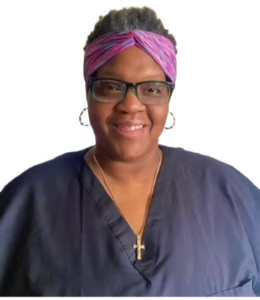 Connect with Tarah
Website: Nurturing Embrace Doula Services
Instagram: @nurturingembracedoulaservices
Facebook: @nurturingembracedoulas